
4.1. CHARACTERISTICS OF OUTDOOR AND EXTREME SPORTS
In recent decades, the popularity of sports practiced outdoors and, more generally, outside predefined architectural structures (e.g., stadiums, tracks), has steadily increased. These sports share specific characteristics and are variously referred to by equivalent terms: extreme sports, action sports, outdoor sports, adventure sports 1.
Most of these activities originated as leisure activities, free from the regulatory constraints typical of traditional sports: without measurable objectives (such as ranking position, time, or score) and without controlled performance conditions (within stadiums or defined courses).
Originally, extreme sports aimed instead at executional perfection and free creative expression, as demonstrated by the widespread presence of freeride and freestyle disciplines, which fully embody these aspects.
These sports are continuously evolving through processes of cross-fertilization and differentiation. Kiteboarding represents a paradigmatic example: its evolution, illustrated in Figure 7, constitutes an emblematic model of this process.
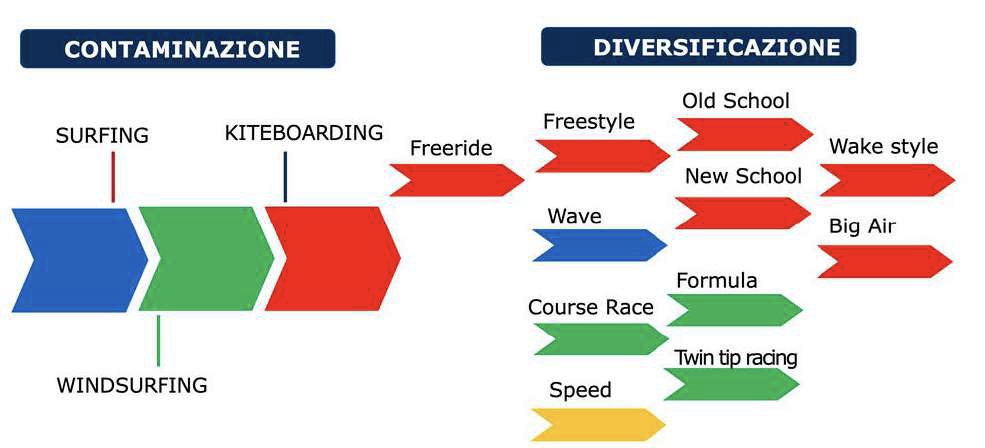
Fig. 1. Origin and development of an extreme sport through cross-fertilization and diversification: kiteboarding. Feletti, Savonitto. G Ital Cardiol, 2024 3
These sports present specific demographic and epidemiological characteristics and therefore require a dedicated approach. For these reasons, and in consideration of the distinctive cultural habitus of participants, the Society pursues the following objectives:
- To promote knowledge and recognition of the specific features of medicine applied to physical activity and outdoor sports.
- To promote the dissemination of appropriate systems and methods for scientific research dedicated to physical activity and outdoor sports.
- To foster awareness among researchers, institutional stakeholders, and civil society of the distinctive sociocultural aspects that characterize these activities.
- To support research, education, and scientific dissemination in the field of medicine applied to these activities.
- To promote and develop:
- collaborations in the healthcare sector;
- research and clinical trials;
- development of guidelines.
- To develop, define, and standardize clinical and operational standards.
4.2. VALUES
The scientific society consistently operates to safeguard health and promotes responsible and informed participation in sports.
Outdoor physical activity and sports support positive and contemporary values. Professional athletes and enthusiasts approach these disciplines with preparation, experience, self-control, and determination. For beginners, the first lesson is always to protect the environment and ensure both personal and collective safety through safe and responsible practice. These principles represent the highest priority in every discipline.
Extreme sports constitute a dynamic domain, intrinsically open to innovation and technology. Although predominantly individual activities, they foster social interaction and the development of an informal collaborative attitude2.
The SARS-CoV-2 pandemic highlighted the potential of these activities as tools to promote physical and mental health and well-being in a safe and responsible manner 3.
It is documented that participation in outdoor physical activity and extreme sports provides benefits across physical, cognitive, psychological, and sociocultural domains, supporting individual development, improving interpersonal relationships, strengthening the relationship with the environment and nature, and fostering ecological awareness 2.
These practices contribute to counteracting sedentary behavior, one of the major public health challenges, and provide a wide range of health benefits.
In particular, outdoor physical activity and extreme sports may:
- improve cardiorespiratory fitness;
- increase muscle strength;
- reduce body fat;
- improve bone health;
- reduce symptoms of anxiety, depression, and autism spectrum disorders;
- improve risk profiles for metabolic and cardiovascular diseases 2,3.
4.3. HEALTH PREVENTION AND THE FIGHT AGAINST SEDENTARY BEHAVIOR IN A ONE HEALTH PERSPECTIVE
The promotion of outdoor sports practice represents a strategic pillar for health prevention, as it impacts multiple determinants of health, in line with the One Health approach. This framework recognizes the interconnection between human health, social well-being, and the environment, highlighting how open, natural, and urban spaces can serve as optimal settings for public health interventions aimed at reducing sedentary behavior.
In particular, outdoor physical activity, including extreme sports, contributes to:
- enhancing cardiorespiratory fitness and muscle strength;
- counteracting sarcopenia and preserving skeletal health;
- reducing body fat accumulation;
- positively modulating symptoms of anxiety, depression, and autism spectrum disorders;
- improving risk profiles in metabolic and cardiovascular diseases 2.
These benefits, beyond their direct impact on individual health, fit within a broader perspective that integrates prevention, environmental sustainability, and social cohesion, in alignment with the principles of the One Health paradigm.
- Cohen R, Baluch B, Duffy LJ. Defining extreme sport: conceptions and misconceptions. Front
Psychol 2018;9:1974. ↩︎ - Brymer E, Feletti F, Monasterio E, Schweitzer R. Understanding extreme sports: a psychological perspective. Front Psychol 2020;10:3029. ↩︎
- Feletti F, Savonitto S. Gli “sport estremi” nel cardiopatico: un inquadramento utile a consigliare i pazienti. G Ital Cardiol 2024; 25. ↩︎